// writing
Field notes
Firsthand notes on protocol engineering, architecture and the craft of shipping. Start with the technical accounts, then explore the dated archive.
Start with the engineering
Original publication · 15 Jan 2020
Understanding DAOs — Governance You Can Read Off the Chain
Most DAO explainers end in utopia. At Trivechain we actually ran one — a masternode-governed treasury denominated in TRVC — and operating it taught me the model's real edges — turnout, weight-based voting, and the rigidity of rules that execute themselves.
Read the account →Work documented · 16 Aug 2019
Storing a Minister's Declarations on Trivechain
A field note on a demonstration we built — writing a minister's declarations onto Trivechain, our own Layer-1, so they are timestamped and independently verifiable from the block explorer. Plus an honest note on what running it on your own chain does and doesn't buy you.
Read the account →Work documented · 12 Mar 2019
TriveAsset — Tokenizing Assets on Trivechain
How we built TriveAsset, the tokenization layer on Trivechain — encoding fungible and non-fungible assets directly on our own UTXO chain, with ownership as a spendable output and the asset's rules as on-chain data. The honest tradeoffs of doing it the UTXO way, and where it ended up — powering TriveCredential.
Read the account →AI systems · interactive work
Inside an AI decision workflow
A teaching demonstration of evidence, policy checks and human review. It is a deterministic simulation, not an LLM or a production evaluation.
Technical notes & personal archive
Dates are preserved. Retrospectives identify the period of the work; original publications identify their publication date. Each article includes context for historical claims and version-sensitive advice.
Productivity · 12 Feb 2025
Original publication
Automate Formatting of Code with Prettier and Husky
Learn how to automate the formatting of your code using Prettier and Husky. This guide walks you through setting up Prettier for consistent code formatting and using Husky to enforce these standards with pre-commit hooks, ensuring a clean and uniform codebase for your team.
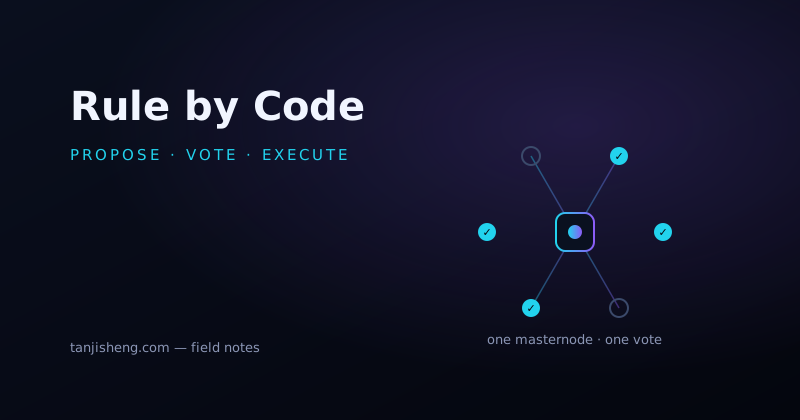
Blockchain · 15 Jan 2020
Original publication
Understanding DAOs — Governance You Can Read Off the Chain
Most DAO explainers end in utopia. At Trivechain we actually ran one — a masternode-governed treasury denominated in TRVC — and operating it taught me the model's real edges — turnout, weight-based voting, and the rigidity of rules that execute themselves.
Blockchain · 16 Aug 2019
Work documented
Storing a Minister's Declarations on Trivechain
A field note on a demonstration we built — writing a minister's declarations onto Trivechain, our own Layer-1, so they are timestamped and independently verifiable from the block explorer. Plus an honest note on what running it on your own chain does and doesn't buy you.
Blockchain · 11 Aug 2019
Original publication
Endless Potential of Blockchain Technology
There are various sectors where blockchain technology can be implemented and it is not restricted only to the realm of the financial sector. For instance, retail and e-commerce services, healthcare services, financial services and real estate industries.
Blockchain · 12 Mar 2019
Work documented
TriveAsset — Tokenizing Assets on Trivechain
How we built TriveAsset, the tokenization layer on Trivechain — encoding fungible and non-fungible assets directly on our own UTXO chain, with ownership as a spendable output and the asset's rules as on-chain data. The honest tradeoffs of doing it the UTXO way, and where it ended up — powering TriveCredential.

Architecture · 18 Apr 2018
Original publication
Blazing Fast Serverless Site
It is actually not possible to host a website without a server or a physical computer that serves the content of the website. So, serverless architectures refer to applications that depend on a third-party services that manage all the infrastructure for you - the mighty cloud service provider

Productivity · 07 Apr 2018
Original publication
Maximizing my productivity while on the go
A developer often has to switch between multiple applications. A typical Android application developer, for example, will have a few applications turned on at any point in time. An IDE, the Android Studio, the application that allows the developer to write code; A website that consists of code example or documentation of how to use a particular function; An emulator or plugged Android phone.

Productivity · 31 Mar 2018
Original publication
365 Days of Procrastination
A personal archive from 2018 about rebuilding my website while pursuing research at MMU.